

Gujarat’s Micro-Business Outstanding Balances Grew at 18% CAGR for Individual Entrepreneurs and 13% for Enterprises Over Three Years
· Gujarat's micro-business credit market reached ₹2.41 lakh crore as of June 2026 with individual borrowing outpacing enterprise lending
· Around 24.8 lakh individual entrepreneurs in Gujarat have never borrowed as enterprises, despite 72% having credit scores above 730
· Nationally, micro business entrepreneurs account for ₹29.6 lakh crore in outstanding commercial credit, with individual borrowing growing at 21% CAGR
Ahmedabad, India, 27th October 2026: Gujarat's micro business entrepreneur (MBE) credit market has reached approximately ₹2.41 lakh crore in outstanding balances as of June 2026, with business-purpose borrowing by individuals growing faster than lending to micro businesses. Over the last three years, outstanding balances held by individual entrepreneurs expanded at an 18% compounded annual growth rate (CAGR), compared with 13% among micro businesses, reflecting the growing role of individual borrowing in financing entrepreneurial activity.
This expansion is also bringing attention to a sizeable opportunity in enterprise-level credit. Approximately 24.8 lakh individual entrepreneurs in Gujarat had never borrowed as enterprises as of March 2026, even as 72% of them had CIBIL Score above 730. These findings, from Micro Business Entrepreneurs in India: Growth, Transformation & Emerging Opportunities, a joint study by TransUnion CIBIL and the National Small Industries Corporation Limited (NSIC), highlight the potential to widen access to structured business financing among entrepreneurs who already have established individual credit profiles.
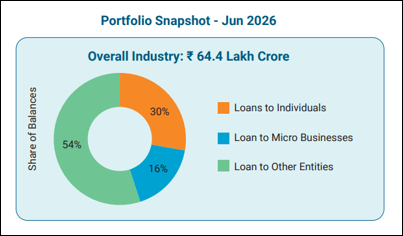
Across India, MBEs accounted for ₹29.6 lakh crore in outstanding commercial credit as of June 2026, representing nearly half of the overall commercial credit portfolio. Of this, ₹19.1 lakh crore was held by individuals borrowing for business purposes and ₹10.5 lakh crore by micro businesses. Individual borrower balances grew at a 21% CAGR over three years, compared with 12% among micro businesses, indicating that business-purpose borrowing in individual capacity is expanding faster than enterprise-level credit.
Chart 1 – Commercial Outstanding Balances
Gujarat's Entrepreneurial Credit Growth Reflects a Strong Manufacturing Base
Gujarat’s micro business credit landscape reflects the state’s established industrial base and diverse financing requirements. Manufacturing accounts for 36% of outstanding balances among micro businesses, with textile industry credit expanding at an 18% CAGR over the last three years. Loans Against Property (LAP) remains the largest financing product, accounting for 38% of overall MBE balances, while cash credit, overdraft and commercial vehicle financing also support entrepreneurial activity. Private sector banks account for nearly 45% of individual business borrower balances, while non-bank finance companies (NBFCs) continue to play an important role in commercial vehicle financing.
Mr. Bhavesh Jain, MD & CEO, TransUnion CIBIL, said: “Gujarat's entrepreneurial ecosystem has a strong manufacturing and trading base, with businesses at different stages of growth requiring different forms of financing. A textile manufacturer investing in capacity, a trader managing inventory and an entrepreneur looking to expand operations have distinct credit requirements. As these businesses grow, lenders have an opportunity to look more closely at their operating cycles, existing credit histories and future financing needs. Helping entrepreneurs build credit relationships in their enterprise capacity can improve their access to suitable financial products and support the next stage of business expansion.”
Bridging the Gap Between Individual Borrowing and Enterprise-Level Credit
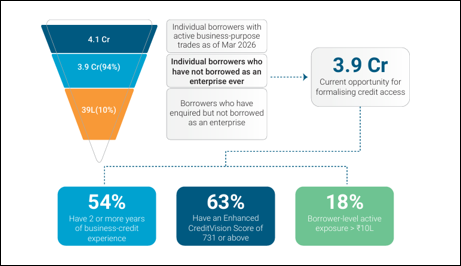
A significant number of India's MBEs have established borrowing histories in their individual capacity but have yet to access credit as formal business entities. As of March 2026, approximately 3.9 crore individual business borrowers across India had never borrowed in an enterprise capacity. Among them, 54% had two or more years of business-credit experience, while 63% had a CIBIL Score of above 730, indicating a substantial pool of borrowers with established credit profiles.
For lenders, this represents an opportunity, subject to their applicable credit policies, underwriting criteria and regulatory requirement, to support entrepreneurs as they progress from individual business borrowing towards enterprise-level credit. Greater access to working-capital facilities, cash credit and overdraft products could help businesses meet evolving financing requirements, while reducing their dependence on personal assets as collateral.
Chart 2 – Opportunity for Formalising Enterprise Credit Access
Gujarat's opportunity for deeper enterprise credit access is supported by the strength of its existing borrower base. As of June 2026, 62% of outstanding individual business borrower balances belonged to the above prime segment1, the highest among the major states analysed. Portfolio performance has also strengthened, with 90+ days delinquency declining by approximately 45 basis points over three years to 1.2%. The combination of established credit histories and improving repayment performance provides a foundation for expanding access to enterprise-level financing among eligible entrepreneurs.
Secured Lending Remains Central to Micro Business Credit
Across India, lending to micro business entrepreneurs remains predominantly supported by secured and collateral-backed products. LAP accounted for ₹10.9 lakh crore in outstanding balances as of June 2026, making it the largest product category, followed by cash credit and overdraft facilities at ₹5.6 lakh crore and commercial vehicle loans at ₹5.0 lakh crore. These financing patterns reflect the continued importance of collateral in supporting business borrowing, while also highlighting opportunities to expand cash-flow-based and working-capital-oriented lending.
The expansion in micro business credit has been accompanied by improving portfolio quality. Overall delinquency levels declined from approximately 3.0% in June 2023 to 1.9% in June 2026, reflecting stronger repayment performance amid sustained credit growth. As financing becomes more accessible, understanding the credit needs and repayment capacity of different entrepreneur segments will remain important for maintaining portfolio resilience.
Enabling the Next Phase of Micro Business Growth
As India's entrepreneurial ecosystem expands, the next phase of micro business credit growth will increasingly depend on enabling businesses to progress towards more structured enterprise financing. Wider adoption of cash-flow-based underwriting, credit guarantee mechanisms and digital financial information can help lenders assess viable businesses beyond traditional collateral-based approaches.
Strengthening the connection between individual business borrowing and enterprise-level credit can support greater formalisation, improve access to financing suited to different stages of business growth and create new opportunities for entrepreneurs across India.
****
1. Enhanced CreditVision (CV) score ranges are: below prime = 300-730; prime = 731-800; above prime = 801-900.
About TransUnion CIBIL
India’s pioneer credit information company, TransUnion CIBIL, ensures the credit history of each person and business entity is reliably represented.
We have developed technology and innovative solutions across core credit, risk and advanced analytics. As a result, consumers and businesses can transact with confidence and achieve great things. We call this Information for Good® — and it leads to economic opportunity, great experiences, and personal empowerment for millions of people and commercial entities in India.
Our customers in India include banks, credit institutions, NBFCs, housing finance companies, microfinance companies, telecom companies and insurance firms.
For more information visit: TransUnion CIBIL Products and Solutions